Travelogue

1. (January 1)
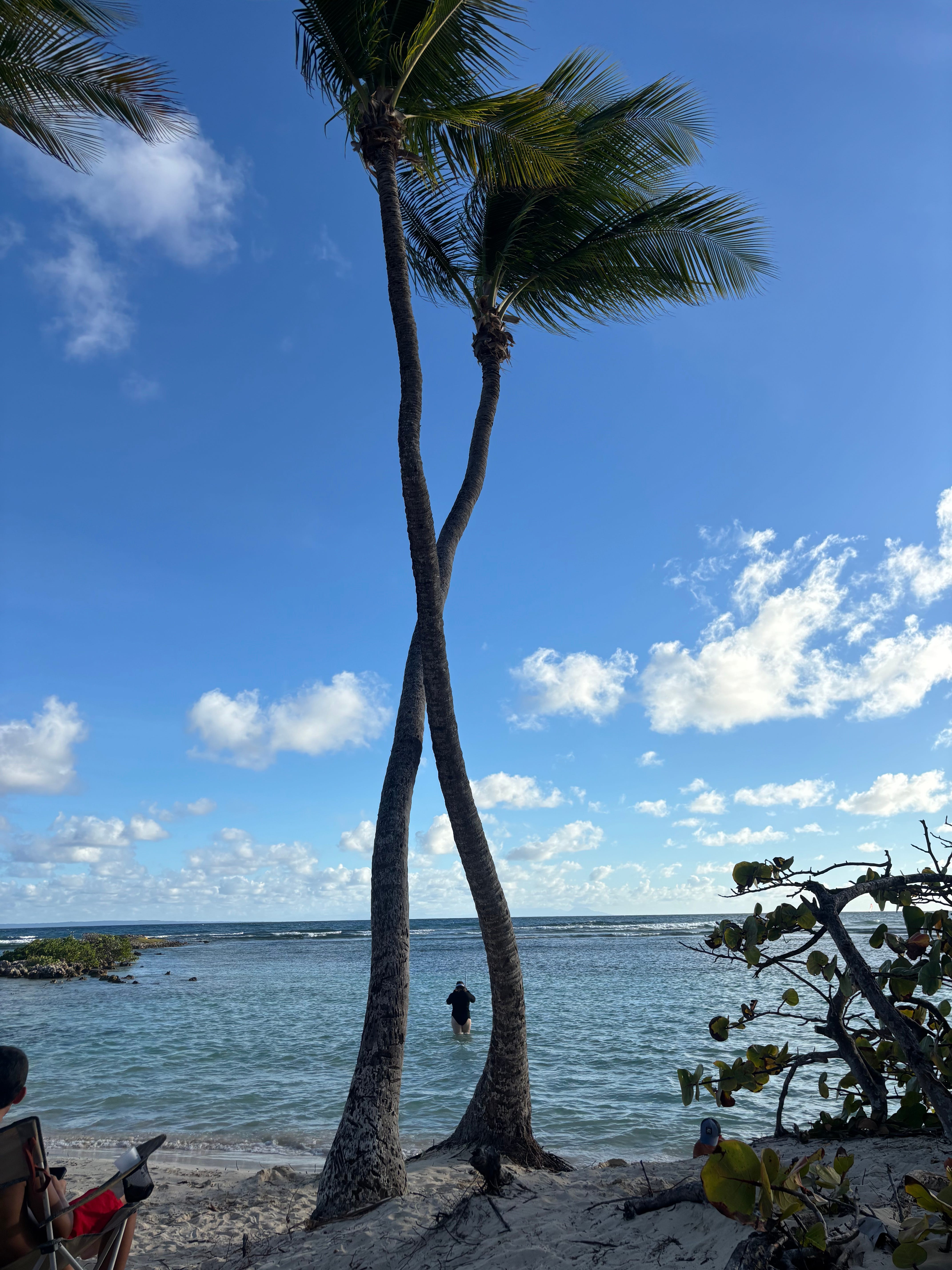
You would think that the older you get, and the more you move about the world, the less dislocated you would feel when you travel somewhere unfamiliar, but it’s the opposite, for me at least: I seem to be growing softer with age, more easily bruise-able by being rolled around the globe, though maybe more self-aware of my predisposition to this injury and more knowledgeable about its remedies. Last night, after a long day of traveling and navigating a new environment in a language in which I have only working proficiency, I treated a generalized sense of anxiety with a couple doses of an English-language sitcom from my childhood, Murphy Brown, drawing closed like a curtain over a window the comfortable world of the television show. Outside our shabby vacation rental, over an ambient orchestra of bugs and frogs, I could faintly hear the locals carousing, and music, and the occasional pop-pop-pop of cheap fireworks, as la Nouvelle Année arrived in Guadeloupe.
2.
Well, the year is well and truly on its way now, like a boat sailing past its harbor’s breakwater. So too Z. and my trip: We have spent the first day of our time here, as one spends one of a handful of coins. And, we’ve begun to be reminded of our differences—which are ultimately minute, but become magnified under the glass of travel, and all the time together and shared decision-making that that entails. My brain, being a human brain, homes in on these dissimilarities as potential threats to group cohesion, but then, Z. and I have been friends for nearly 20 years. An avid birder whose avian evangelism has never been diminished by my indifference, she just interrupted my writing to show me a video she’d taken at the beach, of a frigate bird soaring above the surf: “Isn’t it beautiful?”
3.
When Z. and I sat down to dinner last night, we immediately noticed that the drink menus on the table were almost identical in format to the ones at the restaurant where we’d eaten the night before. On this trip, when I’ve had a question, I’ve challenged myself to ask it en français, so when our server returns, I try: Est-ce qu’il y a un lien entre les deux restaurants? He confirms: same owner. (He actually works at the other restaurant too.) This is somewhat embarrassing for me, since I chose both restaurants. Evidently, the visual language of white-person “cool” is so globally uniform, and I such a sucker for it, that I’d picked two dinner spots that were not only both in that style, but were basically two locations of the same restaurant. I sheepishly sip my French wine and resolve to order some local rum, though I don’t really like the taste.
4.
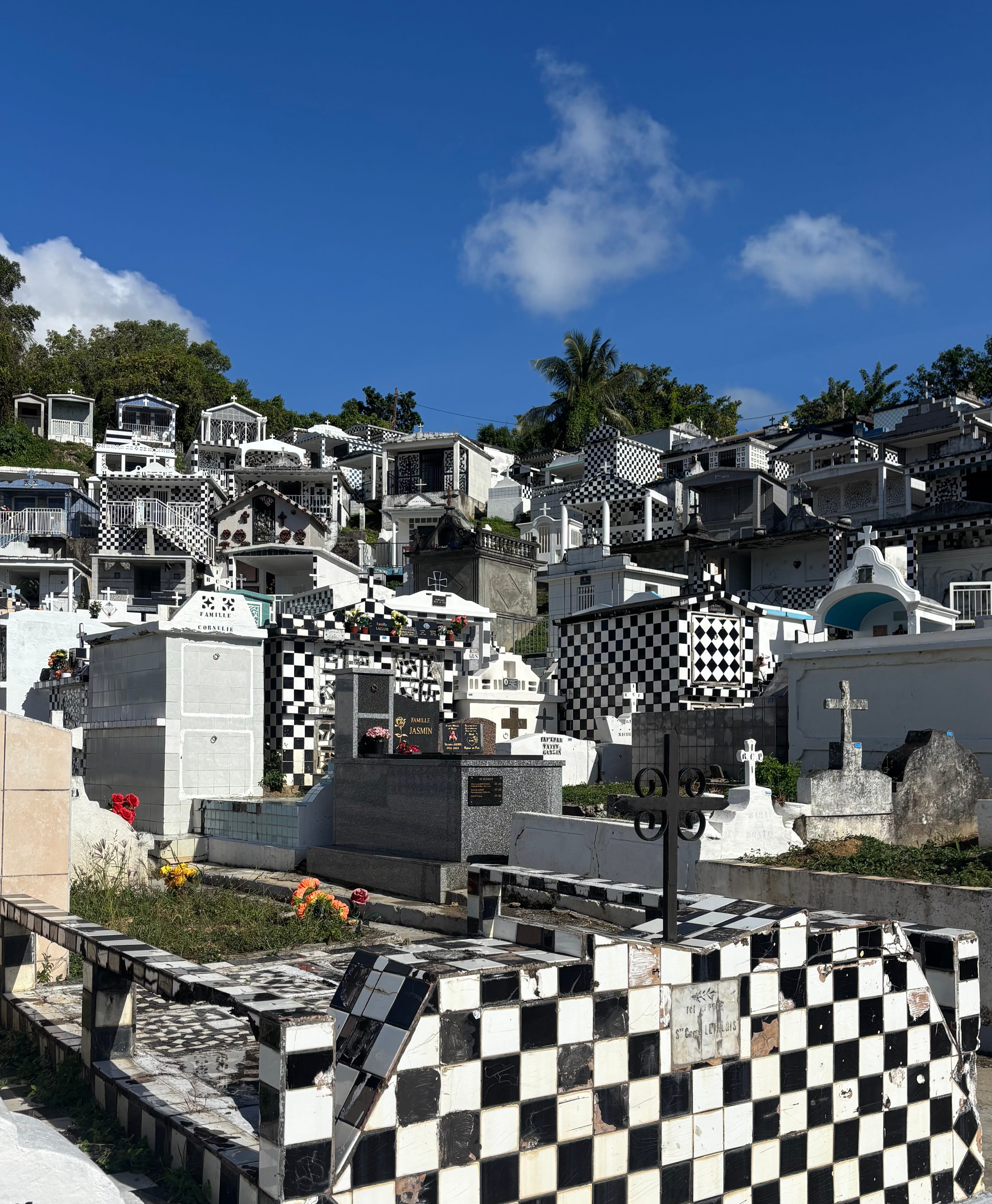
Z. and I split up yesterday: She went to the beach while I went to a cemetery. Le Cimitière de Morne-à-L’Eau is basically a burial ground with a style guide, where nearly all of the mausoleums are tiled in checkered black and white. Constructed on the slopes of a sort of natural amphitheater, the tombs together have a striking effect—and suggest a beautiful sentiment. Out of the deaths of their family members and friends, the Guadeloupeans who’ve buried their loved ones here have co-created what is, basically, a community art project. The graveyard is like a tapestry, weaving once-people from different backgrounds into the same pattern, a primordial interplay of dark and light.
5.
We’ve relocated to the west coast of Guadeloupe (which is technically on a different island than the one we’ve been on). The drive here was only about an hour-and-a-half, but took us through lush jungle and over misty mountains before dropping us to a seashore with a laid-back surf-town vibe. The attraction here, onshore from the teeming marine life of the “Réserve Cousteau,” isn’t in fact surfing, but snorkeling and scuba diving. Not an avid observer of underwater creatures myself, the closest I’ll likely get to the reserve is the Thèrmes de Bouillante, hot springs right in the ocean that Z. and I make our first stop on this side of the islands. Bobbing in the steamy surf, we watch two women—one old, one young—help a very elderly blind man with a scrunched-up face take in the waters, each holding one of his arms. “I hope when I’m old, I have people to help me bathe in the hot springs,” Z. says.
6.
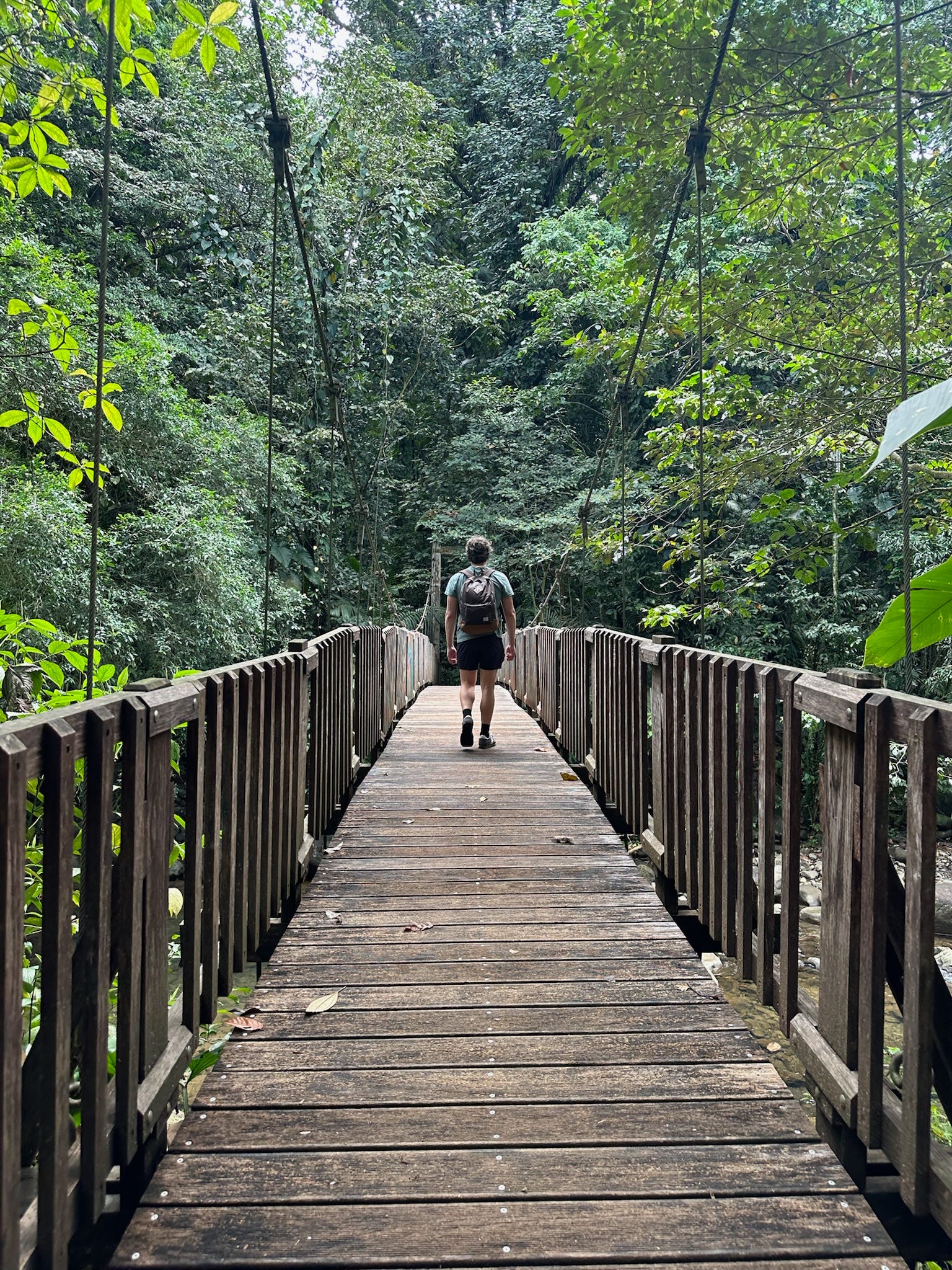
Skipped the last entry because Z. and I got an early start: her for a half-day snorkeling trip in the Réserve Cousteau (rien à voir with Jacques, by the way; it’s just named after him), me to hike La Soufrière, an active volcano and Guadeloupe’s highest point. My hike takes longer than Z.’s trip, so by the time I text her to tell her I’m heading back, she’s already having lunch—with her “new gay friend from Spain.” I meet him back in Bouillante: handsome, with a thin build, curly hair, and dark eyes. He speaks near-perfect English, as well as French (and of course Spanish); later, he tells us he’s a linguaphile who also speaks Italian, Portuguese, and Swedish. As when any gay men meet, there’s a kind of sizing-up happening. I always get a little defensively aloof in those situations, though on this day I sally forth a few times—sneaking glances at him in his swim trunks and making sure he sees it; touching a tattoo on the back of his arm when I ask him about it.
For the rest of the day, we all become what Z. calls “travel companions,” hopping up and down the local coast from beach (Z. and the Spanish boy saw sea turtles there on their snorkeling trip, but when we return they’re nowhere to be found), to hot springs (the Bains Thomas, which are beautiful, but not hot), to more hot springs (the Thèrmes de Bouillante again, which are hot, but which, we learn, aren’t true hot springs; they’re just the spot where the local geothermal energy plant releases water into the ocean—ha!). When we part ways, Z. and the Spanish boy exchange Instagram handles, but I don’t have Instagram—tant pis. I’d rather not have a parasocial relationship with this boy anyway, viewing each other’s stories for the next however-many years. He’ll stay here, a bit salt-and-peppery but otherwise un-aging, on the beach of the island of my mind.
7.
Overnight layover in Miami: Neither Z. nor I had been there before, so we intentionally stayed in what the internet said was a cool neighborhood (Wynwood) and planned to hit up a gay bar. Unfortunately, the queer nightlife scene in Miami seems to be struggling in DeSantis’ Florida. One bar in the area that Reddit recommended had closed last year. When we got to another (cutely called “Gramps”), we learned that it too had shuttered, just days before. A lonely disco ball was still twirling on the empty patio.
8.
I’m writing this from my couch in Oakland, though I can feel that my body is still on Atlantic time and is wondering, in the way bodies wonder, why I slept from 5:30 pm to 3:30 am last night.
To help myself stay up until a reasonable Pacific bedtime after flying back from Florida, I watched the documentary The Perfect Neighbor (which, aptly, takes place in Florida). Comprised mostly of police body-cam footage, the film tells the story of a white woman who, after repeatedly calling the cops about her Black neighbors’ kids playing near her house, shoots and kills one of those neighbors, a woman named Ajike Owens. In a state with a “stand your ground” law, the shooter claimed she feared for her life, though she fired through her closed, locked front door. The film was a perfect depiction of how racism and gun violence work in America. After watching it, I felt all too re-acclimated.
JF